
Anchoring Bias
Tendency to rely heavily on a historical reference point or one piece of information.
Call Option
An option to buy a stock at a specific price in the future, no matter the current stock price
Cognitive Dissonance
Your brain is struggling with two opposite ideas, causing you psychological pain. People will ignore, reject, or minimize information that conflicts with their positive self-image.
Commitment Bias
After you have committed to an action, you tend to continue with that action, even though there are undesirable outcomes. This bias is stronger if the commitment is public.
Confirmation Bias
Seeking or over-emphasizing information conforming to your current beliefs and disregarding conflicting information.
Disposition Effect
Tendency to sell winners and keep losers; i.e., sell winning stocks but keep losing stocks. This is tied to pride in choosing winners and regret in choosing losers.
Endowment Effect
The endowment effect is when people demand more to sell an object than they would be willing to buy.
Familiarity bias
The tendency to prefer things that are familiar to them even if it is not the best choice
Herd Behavior
Tendency to follow the crowd as you feel safer than making a decision on your own.
House Money Effect
After people have experienced a financial gain or profit, they tend to be riskier in investing. They feel they are playing with “house money” as they say in gambling.
Illusion of Control
The belief you have influence over uncontrollable events due to a choice, past success, information, active involvement, task familiarity, and outcome sequence
In the Money
In referring to options, In-the-money (ITM) means that for a call option, the strike price is lower than the current price, and for a put option, the strike price is higher than the current price, so your options have a profit at this point in time.
Long Straddle
An options strategy is used when you feel a stock will move dramatically one way or the other but don’t know which way, so you purchase a call option and a put option at the same strike price.
Loss Aversion Bias
Tendency to avoid the psychological pain of loss because it is twice as powerful emotionally as acquiring gains.
Mental Accounting
Treating money differently depending on how it was acquired.
Overconfidence Bias
Tendency to see ourselves better than we really are.
Prospect Theory
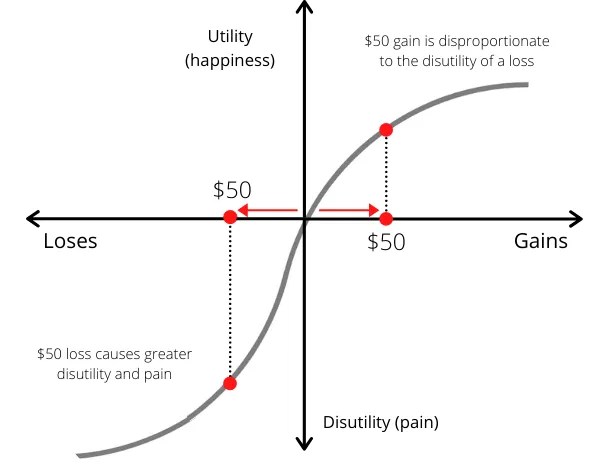
Prospect theory is the way people frame an uncertain decision. They look at the decision in terms of gains and losses. However, losses cause much more emotional pain than equivalent gains. This chart shows how the same amount of loss is twice as emotionally painful as the same amount of gain; i.e., losing $50 feels much worse than gaining $50 in feeling better.
Out of the Money
In referring to options, out-of-the-money (OTM) means that for a call option, the strike price is higher than the current price, and for a put option, the strike price is lower than the current price, so your options are worthless at this point in time.
Put Option
An option to sell a stock at a specific price in the future, no matter the current stock price.
Risk Aversion or Snake Bite Effect
After experiencing a financial loss, some people tend to be less risky. They feel they are unlucky and may continue to be unlucky.
Status Quo Bias
A tendency to keep what they have than exchange it.
Strike Price
In options trading, the strike price is the price you can exercise, not the price you paid for the option itself. For example, if you bought a call option (option to buy) for $0.25 at a strike price of $5 and the current underlying stock price is $6, then you can exercise this option and make a $1 profit per share minus the $0.25 cost of the option.
Sunk Cost Effect
Consideration of non-recoverable costs, time, or resources in deciding the future.
Try to Break Even Effect
After experiencing a financial loss, some people jump at the chance to make up their losses with riskier investments.
 Behavioral Investing and Finance